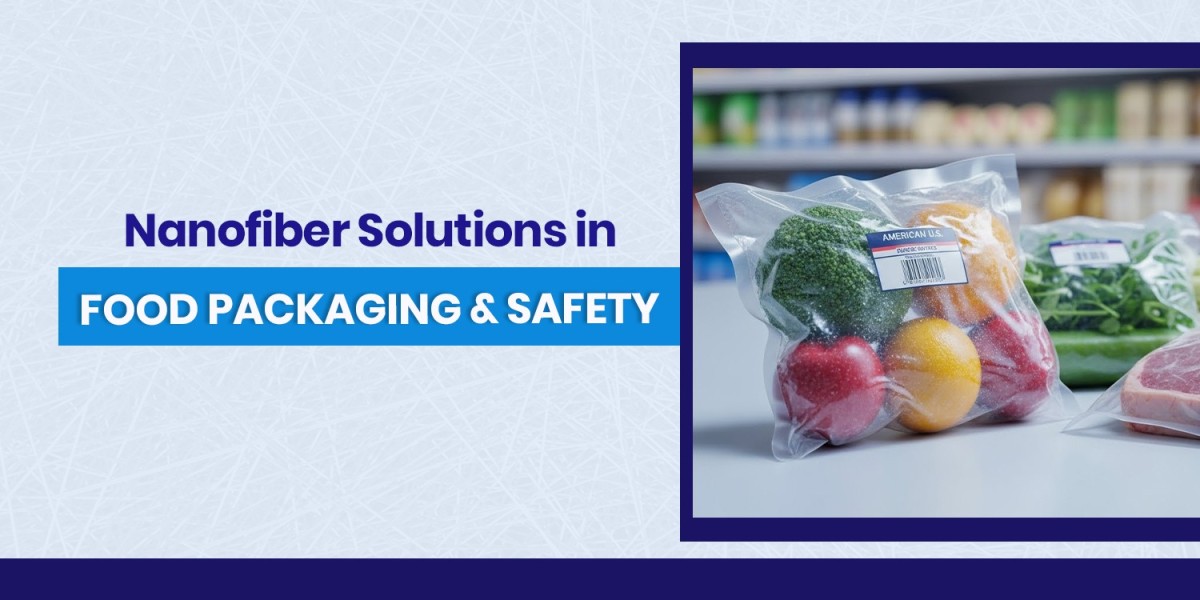

Food packaging does much more than make products convenient to store and transport. It plays an important role in protecting food from moisture, oxygen, microorganisms, contamination, and physical damage. As the food industry looks for more effective and sustainable packaging technologies, nanofibers are opening new possibilities.
Nanofiber Solutions in Food Packaging can provide lightweight protective barriers with unique functional properties. Their extremely small fiber diameters, high surface area, and customizable structure make them useful for developing advanced packaging materials designed to improve food quality, extend shelf life, and support food safety.
What Are Nanofiber Solutions in Food Packaging?
Nanofibers are extremely fine fibers, often produced using technologies such as electrospinning. These fibers can be manufactured from different polymers, including synthetic, natural, and biodegradable materials.
In food packaging, nanofibers can be incorporated into films, coatings, membranes, and multilayer structures. Unlike conventional packaging that mainly acts as a passive physical barrier, advanced nanofiber materials can be engineered to provide additional functionality.
For example, Nanofiber Solutions in Food Packaging may be designed to control moisture, improve gas barrier performance, carry antimicrobial agents, or support active packaging applications. This flexibility makes nanofiber technology particularly interesting for foods that are sensitive to environmental conditions.
How Nanofibers Can Improve Food Safety
Food safety remains one of the most important concerns throughout the food supply chain. Microbial contamination can reduce shelf life and, in some cases, create health risks.
Nanofiber-based packaging provides a platform for developing antimicrobial surfaces. Functional compounds can be incorporated into or deposited onto nanofibers so that the packaging helps inhibit the growth of certain bacteria and fungi.
Depending on the application and applicable food-contact regulations, researchers are investigating antimicrobial agents such as natural extracts, essential oils, biopolymers, and other functional compounds.
Because nanofibers have a high surface-area-to-volume ratio, they can provide efficient interaction between the packaging surface and its surrounding environment. This characteristic makes Nanofiber Solutions in Food Packaging promising for active food protection.
Better Barrier Properties for Food Protection
Exposure to oxygen and moisture can significantly affect food quality. Oxygen can accelerate oxidation, while excessive moisture can influence texture and encourage microbial growth.
Nanofiber layers can be engineered as part of multilayer packaging systems to improve barrier performance. Their structure and composition can be customized according to the needs of a specific food product.
Potential advantages include:
- Improved moisture management
- Enhanced oxygen barrier performance
- Better protection against external contaminants
- Greater control over packaging permeability
- Functional layers without excessive material weight
These properties may be particularly valuable for meat, dairy products, fruits, vegetables, bakery products, and other foods with limited shelf lives.
Extending the Shelf Life of Food
Reducing food waste is a major goal across the food industry. Packaging that maintains food quality for longer can help reduce product losses during transportation, retail storage, and consumer use.
Nanofiber Solutions in Food Packaging can contribute to shelf-life extension by creating controlled environments around packaged foods. Nanofiber layers may help regulate moisture and gas exchange while also serving as carriers for active compounds.
For fresh produce, for example, carefully designed packaging can help manage humidity and gas transfer. For other products, functional nanofiber layers may help slow oxidation or microbial deterioration.
The exact performance depends on the polymer, fiber structure, incorporated compounds, food type, storage environment, and overall packaging design.
Nanofibers and Sustainable Food Packaging
Sustainability has become another major consideration in packaging development. Conventional plastic packaging provides excellent performance but can contribute to long-term waste when it is not effectively recycled or recovered.
Researchers and manufacturers are therefore exploring biodegradable and bio-based materials for nanofiber production. Polymers and natural materials such as cellulose derivatives, chitosan, gelatin, polylactic acid (PLA), and other biopolymers may be suitable for specific nanofiber applications.
Using these materials could help manufacturers develop packaging with both functional performance and improved environmental characteristics.
However, sustainability depends on the complete packaging system. Material sourcing, manufacturing energy, recyclability, compostability, product protection, and end-of-life management should all be considered when evaluating environmental benefits.
Active and Intelligent Packaging Applications
One of the most exciting areas for Nanofiber Solutions in Food Packaging is the development of active and intelligent packaging.
Active packaging interacts with the packaged product or surrounding environment to help maintain quality. Nanofiber structures can potentially carry antioxidants, antimicrobial compounds, moisture-control agents, or other active ingredients.
Intelligent packaging takes this concept further by providing information about the condition of a product. Researchers are investigating nanofiber-based sensing systems that could potentially respond to changes in temperature, freshness, gases, humidity, or other environmental factors.
Future packaging could therefore do more than protect food. It may also help manufacturers, retailers, and consumers understand whether appropriate storage conditions have been maintained.
Challenges to Consider
Despite their potential, nanofiber packaging technologies must overcome several challenges before widespread commercial adoption.
Food-contact safety is a critical consideration. Materials, additives, and functional compounds must meet applicable regulatory requirements. Manufacturers also need to evaluate possible material migration, stability, durability, production scalability, and compatibility with existing packaging processes.
Cost-effective large-scale manufacturing is another important factor. Laboratory results must translate into reliable industrial processes capable of producing consistent materials at commercially practical volumes.
Addressing these challenges will be essential for expanding Nanofiber Solutions in Food Packaging from research environments into broader commercial use.
The Future of Nanofiber Food Packaging
Demand for safer, smarter, and more sustainable packaging is encouraging continued innovation in materials science. Nanofiber technology provides a versatile platform for developing thin functional layers that can enhance traditional packaging systems.
From antimicrobial surfaces and moisture management to active packaging and potential freshness monitoring, Nanofiber Solutions in Food Packaging could play an important role in the next generation of food protection.
As research, manufacturing technologies, and regulatory understanding continue to advance, nanofibers may help food producers achieve better performance while reducing unnecessary material use and food waste.
Conclusion
Nanofiber Solutions in Food Packaging offer exciting opportunities to improve food safety, shelf life, barrier performance, and packaging functionality. Their highly customizable structure allows engineers to develop materials for specific food protection requirements while also exploring more sustainable packaging approaches.
Matregenix specializes in advanced nanofiber materials and electrospinning solutions for a wide range of applications. By leveraging expertise in nanofiber development and manufacturing, Matregenix can support organizations exploring innovative material solutions for food packaging, filtration, and other advanced applications.