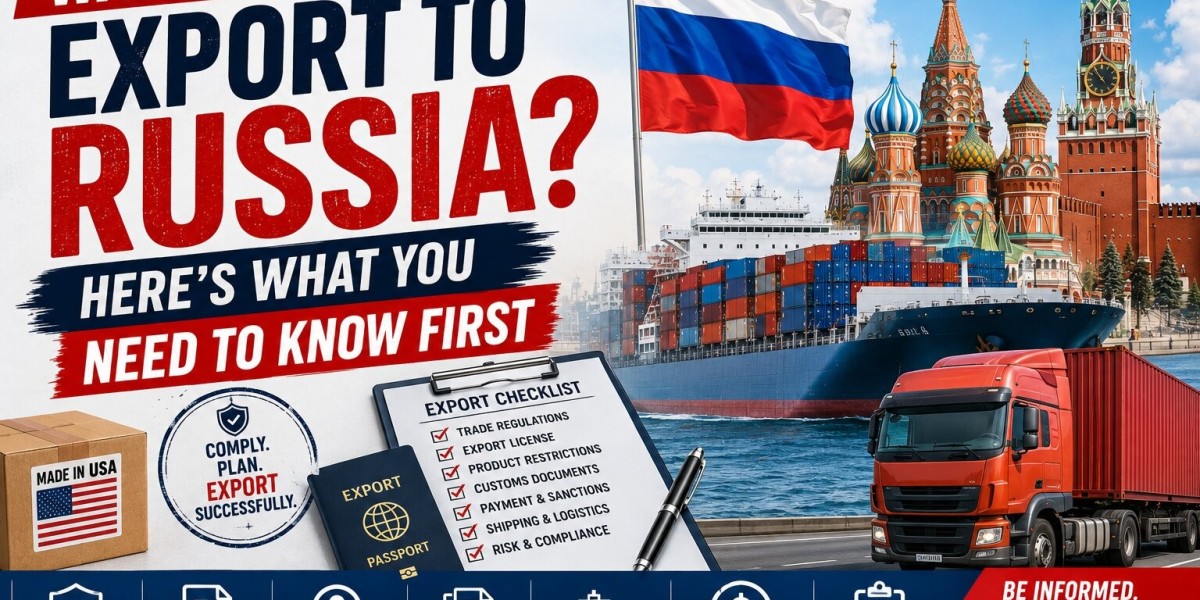

Exporting products to another country can open new opportunities for a growing business. But when the destination is Russia, the usual international trade checklist is not enough.
For U.S. businesses, exporting to Russia in 2026 requires careful attention to sanctions, export controls, product restrictions, end users, payment channels, and potential diversion risks. The U.S. Bureau of Industry and Security (BIS) maintains stringent Russia-specific export controls, while the Treasury Department's Office of Foreign Assets Control (OFAC) administers several Russia-related sanctions programs.
That does not mean every possible transaction is automatically prohibited. It means that an exporter needs to determine whether a particular product, customer, transaction, service, and payment arrangement is legally permitted before committing to the deal.
This distinction is critical.
A company should never assume that because a product is ordinary or because a Russian customer is willing to buy it, the transaction is automatically legal.
So, if your business is considering an export to Russia, what should you check first?
Let's walk through the major issues.
Is It Still Possible to Export to Russia?
This is one of the first questions businesses ask.
The answer is more complicated than simply saying yes or no.
U.S. regulations impose extensive restrictions on exports, reexports, transfers, services, and transactions involving Russia. BIS states that it has implemented stringent export controls since February 24, 2022, including restrictions on technologies and other products that could support Russia's military capabilities.
At the same time, OFAC's Russia-related sanctions are not structured as one simple rule covering every commercial transaction. The Treasury maintains multiple Russia-related sanctions programs, executive orders, directives, general licenses, and other authorities.
Therefore, the correct approach is not:
"Can Americans export anything to Russia?"
Instead, ask:
"Is this particular transaction authorized under the rules that apply to my product, customer, end use, and destination?"
That question leads to a much safer export process.
1. Start by Identifying Your Exact Product
Before looking for a Russian buyer, understand exactly what you are selling.
Create a detailed description of the product, including:
- Product name
- Model number
- Technical specifications
- Materials
- Components
- Intended use
- Country of origin
- Software included
- Technology included
- Accessories
- Replacement parts
- Documentation supplied with the product
Avoid relying on vague descriptions.
For example, "industrial equipment" tells a compliance professional very little.
A description such as "computer-controlled industrial milling machine with specified control software" provides much more information for determining whether export controls could apply.
This level of detail matters because BIS controls products according to specific technical and regulatory criteria.
2. Determine Whether the Product Is Subject to the EAR
For many U.S. commercial exports, the Export Administration Regulations (EAR) are a central part of the analysis.
BIS explains that the EAR generally covers commodities, software, and technology that fall within its jurisdiction. The regulations also contain rules concerning certain foreign-made products containing controlled U.S.-origin content and certain foreign-produced direct products.
The first step is therefore to determine whether your product is subject to the EAR.
Do not skip this step simply because your product is commercially available.
A product can be subject to export controls even when it is not military equipment.
3. Determine the Correct ECCN
If your product is subject to the EAR, you may need to determine its Export Control Classification Number, or ECCN.
The ECCN can affect the licensing analysis.
This is different from the HS code used for customs classification.
An HS code generally helps classify goods for customs and trade purposes.
An ECCN is used within the U.S. export-control system to identify certain items subject to the EAR.
Depending on the product, you may also encounter an EAR99 classification.
However, EAR99 does not automatically mean "free to export anywhere."
Russia-specific controls can apply to certain EAR99 items as well.
BIS's current Russia provisions include license requirements covering specified industrial goods, itemized goods, luxury goods, and certain software, in addition to controls based on ECCNs and end uses or end users.
4. Check Russia-Specific License Requirements
This is where exporting to Russia becomes substantially different from many ordinary international shipments.
Under the current EAR provisions, BIS requires licenses for numerous categories of items destined for Russia or Belarus.
For example, BIS states that a license is required for items subject to the EAR classified under ECCNs on the Commerce Control List when exported, reexported, or transferred to or within Russia or Belarus, subject to the applicable rules and exclusions.
Additional controls apply to certain industrial goods, itemized items, luxury goods, software, and products associated with particular end uses or end users.
This means you should not rely on a generic statement such as:
"My product isn't military equipment, so I don't need a license."
That assumption can be dangerous.
The actual classification and Russia-specific provisions must be reviewed.
5. Screen the Russian Buyer
Knowing what you are selling is only half the analysis.
You also need to know who will receive it.
Before completing an export to Russia, conduct appropriate screening of:
- Buyer
- Consignee
- End user
- Owners
- Intermediaries
- Freight parties
- Banks
- Other relevant transaction participants
OFAC maintains sanctions lists that include blocked persons and entities. The Treasury's Russia sanctions program continues to receive updates, including designations and changes during 2026.
Do not assume that screening only the company name is enough.
Ownership and intermediary relationships can matter as well.
A seemingly ordinary buyer can create significant compliance problems if the transaction ultimately benefits a prohibited person or involves a restricted party.
6. Understand the End Use
The buyer's identity is important, but so is the intended use of the product.
Ask:
- What will the product be used for?
- Where will it be installed?
- Who will operate it?
- Who ultimately benefits from the transaction?
- Could it be incorporated into another product?
- Could it be diverted to a restricted end user?
BIS maintains end-use and end-user controls that can apply even when a product's classification alone does not tell the entire story.
This is particularly important for products that could have military, intelligence, surveillance, industrial, or other sensitive applications.
If a buyer refuses to explain the intended use, that should be treated as a warning sign rather than ignored.
7. Pay Attention to Diversion Risks
A major issue in the current export environment is diversion.
A product may not be shipped directly from the United States to a restricted Russian customer.
Instead, someone might propose routing the goods through another country.
For example:
United States → Country A → Russia
That does not automatically make the transaction acceptable.
BIS has specifically targeted procurement networks and diversion strategies involving Russia. The agency has also highlighted the risks surrounding certain high-priority products that Russia seeks to procure for military-related purposes.
A foreign intermediary should therefore not be viewed simply as a way around Russia-specific restrictions.
The exporter remains responsible for understanding the transaction and applicable export-control rules.
8. Be Careful With the Common High Priority Items List
BIS has developed the Common High Priority Items List, or CHPL, with international partners.
The list identifies products using six-digit HS codes that Russia seeks to procure for weapons programs. BIS describes these products as having heightened diversion risk because of their importance to Russia's military efforts.
If your product falls within this type of category, conduct additional due diligence.
This does not mean that every product appearing on such a list should be treated identically in every transaction.
It means the product deserves heightened attention.
9. Do Not Assume a Third-Country Shipment Solves the Problem
This is a particularly important point for exporters.
A buyer may say:
"Don't worry. We'll import it through another country."
That statement should immediately trigger additional questions.
Export-control rules can apply to reexports and transfers after the original export.
BIS has repeatedly emphasized that U.S.-origin controlled items can remain subject to the EAR outside the United States.
The agency has also taken action against networks involved in diversion of U.S.-origin and U.S.-branded products to Russia.
Therefore, routing a shipment through another country is not a substitute for compliance.
10. Review OFAC Sanctions Separately
BIS and OFAC are not the same thing.
BIS primarily administers the EAR and many U.S. export controls.
OFAC administers U.S. economic sanctions.
A transaction can therefore require analysis under both systems.
OFAC currently maintains Russia-related sanctions under multiple authorities, including the Russian Harmful Foreign Activities Sanctions and Ukraine-/Russia-related sanctions programs.
OFAC also continues to update Russia-related general licenses, FAQs, and sanctions designations. For example, Treasury issued amended Russia-related General License 13R in July 2026.
This is why an old article or outdated compliance checklist may not be enough for a current transaction.
11. Check the Payment Method Before Accepting the Order
Finding a willing buyer does not guarantee that you can receive payment.
Russia-related financial restrictions can affect:
- Banks
- Financial institutions
- Correspondent accounts
- Payment channels
- Currency transactions
- Sanctioned entities
OFAC has specific restrictions involving certain Russian financial institutions and government-related entities, while certain transactions may be authorized through applicable general licenses or exemptions.
Therefore, ask your bank or qualified sanctions professional to review the proposed payment structure before accepting the order.
Do not wait until the goods are ready to ship.
12. Understand That Trade and Sanctions Rules Can Change
One of the biggest challenges when you export to Russia is that the regulatory environment is not static.
OFAC's recent-actions pages show continuing Russia-related designations, removals, amended general licenses, and regulatory updates during 2026.
BIS also states that its Russia and Belarus export-control resources are updated as events warrant.
That means a compliance decision made several months ago may need to be reviewed again.
For businesses conducting recurring transactions, establish a process for checking regulatory changes before significant shipments.
13. Review Your Product's HS Code
Although the ECCN is important for U.S. export controls, the HS code still matters for international trade.
Your product's HS classification can affect:
- Customs treatment
- Import duties
- Statistical reporting
- Import documentation
- Product restrictions
Make sure the classification is accurate.
Do not use an HS code simply because a supplier, buyer, or freight forwarder suggested it.
If classification is unclear, obtain professional advice or pursue the appropriate customs ruling process where available.
14. Calculate the Complete Cost
Compliance is not the only challenge.
You also need to determine whether the transaction makes financial sense.
Your export cost may include:
- Product cost
- Packaging
- Inland transportation
- Export handling
- Freight
- Insurance
- Brokerage
- Customs charges
- Banking costs
- Compliance costs
- Storage
- Final delivery
Russia-related transactions can also involve additional logistical and financial complications.
Therefore, calculate the complete transaction cost before quoting the buyer.
A sale that looks profitable based on product price alone may not remain attractive after all expenses are included.
15. Choose the Shipping Route Carefully
Transportation to Russia can involve complicated routing.
Before choosing a carrier or logistics provider, evaluate:
- Available routes
- Transit time
- Carrier restrictions
- Transshipment points
- Insurance
- Customs requirements
- Sanctions exposure
- Final delivery arrangements
Never select a route solely because it is inexpensive.
The logistics provider should understand the compliance environment and be able to explain how the shipment will move from origin to final destination.
16. Prepare Accurate Export Documentation
Your documentation should accurately describe the transaction.
Depending on the shipment, documents can include:
- Commercial invoice
- Packing list
- Bill of lading
- Air waybill
- Export filing
- Product information
- License information
- End-user statements
- Certificates
- Other supporting records
Descriptions should be specific and truthful.
Do not intentionally change product descriptions to make a shipment appear less sensitive.
That can create a much more serious compliance problem than the original transaction.
For applicable exports, Electronic Export Information is filed through the Automated Export System. BIS explains that EEI collects information including parties to the transaction, ECCN where required, Schedule B or HTS number, description, quantity, value, and license authority.
17. Review Your Contract Terms
International contracts should clearly define responsibilities.
Consider addressing:
- Product specifications
- Quantity
- Price
- Payment terms
- Delivery terms
- Incoterm
- Inspection
- Insurance
- Documentation
- Compliance obligations
- Diversion restrictions
- Reexport restrictions
BIS has previously issued guidance encouraging exporters to use contract language that makes overseas customers aware that U.S. export controls can continue to apply and that many items cannot be reexported to Russia without authorization.
Contract language should complement—not replace—actual compliance screening.
18. Be Careful With "Easy Workarounds"
If someone proposes:
- Changing the product description
- Using another company's name
- Routing through a different country
- Hiding the final customer
- Splitting the shipment
- Using an unusual payment method
- Removing U.S. branding
- Creating misleading invoices
stop and investigate.
A workaround that appears clever may actually create evidence of intentional evasion.
The safest approach is to determine whether the transaction is legally authorized and document the reasoning behind that conclusion.
Common Mistakes Businesses Make
Assuming Every Export to Russia Is Prohibited
The rules are complex and transaction-specific. Some activities may be authorized or exempt, while others are prohibited or require licenses.
Assuming Every Export Is Permitted
The opposite assumption is equally dangerous.
Russia has extensive export-control and sanctions restrictions.
Screening Only the Buyer
You may also need to review ownership, end users, intermediaries, banks, and other parties.
Ignoring the End Use
A product's technical classification is not always the only issue.
Treating a Third Country as a Shortcut
Transshipment does not automatically remove U.S. export-control obligations.
Using Outdated Information
Russia-related rules have changed repeatedly. Always check current official guidance.
Accepting Payment Before Compliance Review
A transaction can encounter problems even after a buyer agrees to purchase.
A Practical Pre-Shipment Checklist
Before completing an export to Russia, ask:
Product
- What exactly am I exporting?
- Is it subject to the EAR?
- What is the ECCN?
- Is it EAR99?
- Is it listed under Russia-specific controls?
- Does it appear on a high-priority list?
Customer
- Who is the buyer?
- Who owns the buyer?
- Who is the ultimate end user?
- Has everyone been screened?
End Use
- What will the product be used for?
- Where will it be installed?
- Could it be diverted?
Sanctions
- Does OFAC restrict any party?
- Is the transaction covered by a general license?
- Are any banks involved subject to restrictions?
Logistics
- What route will the shipment take?
- Are any intermediaries involved?
- Does the carrier accept the transaction?
Documentation
- Are the invoice and packing list accurate?
- Is the product description complete?
- Is EEI filing required?
- Is a license required?
Financials
- What is the complete transaction cost?
- Can the payment be processed legally?
- Does the transaction remain commercially viable?
Final Thoughts
The biggest lesson for businesses considering an export to Russia is simple: do the compliance work before the commercial commitment becomes difficult to unwind.
Russia is not an ordinary export market for U.S. companies in 2026.
BIS maintains extensive Russia-specific export controls, and OFAC continues to administer and update multiple Russia-related sanctions programs.
At the same time, the rules are not necessarily a simple blanket prohibition covering every conceivable commercial transaction. The legality of a proposed transaction depends on the product, classification, parties, end use, destination, payment structure, applicable sanctions, and any available authorization.
That is why exporters should avoid relying on assumptions.
Instead, start with the product.
Classify it correctly.
Determine whether it is subject to the EAR.
Check the relevant Russia-specific controls.
Screen every important party.
Understand the end use.
Review OFAC requirements.
Check payment channels.
Plan the logistics.
Prepare accurate documentation.
And, most importantly, verify the rules as they exist when the transaction actually takes place.
For complicated or high-risk transactions, businesses should obtain advice from qualified export-control and sanctions professionals rather than relying solely on general online information.
International trade can be rewarding, but successful exporting is built on preparation. When a destination carries significant regulatory risk, careful preparation is not an administrative burden—it is part of the business strategy.
Frequently Asked Questions
Can U.S. companies still export to Russia in 2026?
Some transactions may be legally possible, but extensive U.S. sanctions and export controls apply. The legality depends on the product, parties, end use, payment structure, and applicable authorizations.
Do all products require an export license for Russia?
No single answer applies to every product. BIS's Russia rules impose license requirements on numerous categories, including certain ECCNs, industrial goods, itemized products, luxury goods, software, and transactions involving certain end uses or end users.
Does EAR99 mean I can freely export to Russia?
No. EAR99 describes an item that is subject to the EAR but not specifically listed on the Commerce Control List. Russia-specific controls can still impose licensing requirements on certain EAR99 products or transactions.
Can I ship products through another country before sending them to Russia?
Using a third country does not automatically eliminate U.S. export-control obligations. Reexports, transfers, diversion, and foreign direct product rules can be relevant depending on the transaction.
Should I check OFAC as well as BIS?
Yes. BIS administers the EAR and many export controls, while OFAC administers U.S. economic sanctions. A transaction may need to comply with requirements administered by both agencies.
Where should exporters check current Russia requirements?
BIS's Russia and Belarus export-control resources and OFAC's Russia-related sanctions pages are important starting points. Both agencies update their guidance and restrictions as circumstances change.