
It is one of the first hurdles, and for many students, it feels like the most stressful one. You have your academic transcripts in order, your statement of purpose has been drafted, and your university shortlist is ready. But then the question lands on your desk: which English proficiency test should you actually take?
For decades, the IELTS (International English Language Testing System) was the default answer. It was the gold standard. But over the last few years, PTE (Pearson Test of English) has emerged as a formidable, tech-driven alternative. It has disrupted the market so significantly that students now find themselves caught in a genuine dilemma. As education consultants, we see this confusion every single day, and the decision is rarely about which test is "easier." It is about which test is strategically smarter for your specific context.
The Core Distinction: Human Judgement vs. Machine Precision
This is not just a difference in branding; it is a difference in philosophy.
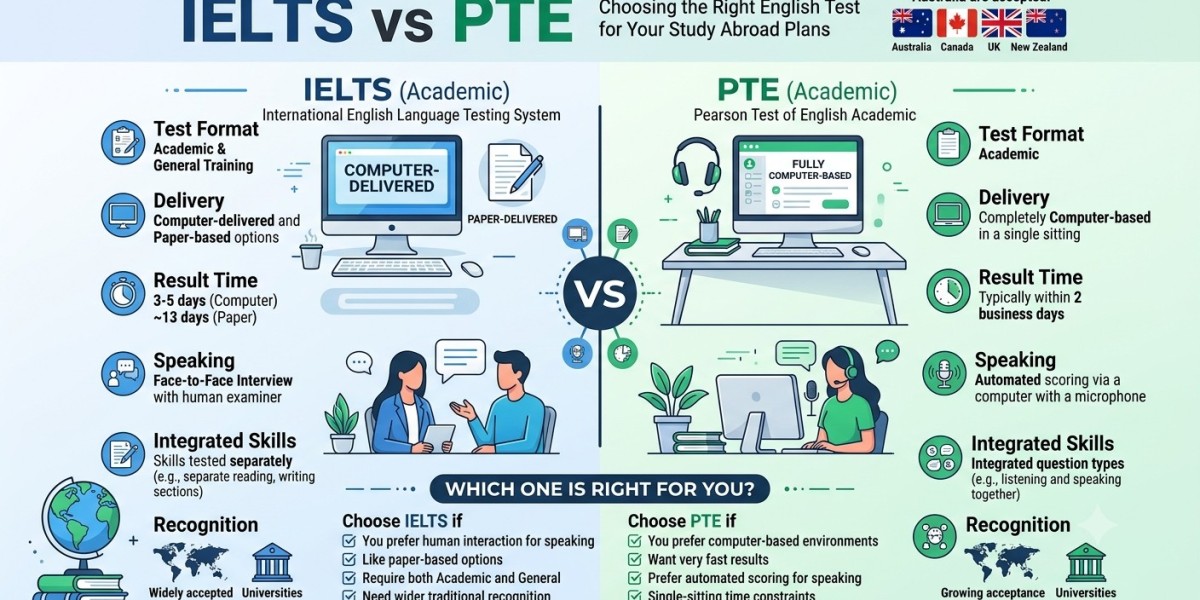
IELTS, particularly the Academic version, is a human-centric test. When you sit for the speaking module, you are talking to a certified examiner. When you write your essays, a human being reads them, interprets your argument, and judges your coherence. This introduces a variable that many students overlook: examiner bias. Not in a corrupt sense, but in a purely human sense. If your accent is thick or your handwriting is messy in the paper-based version, you are fighting an uphill battle.
PTE, on the other hand, is entirely digitised. It is an algorithmic test. You speak into a headset, and a sophisticated AI system analyses your fluency, pronunciation, and oral discourse. It does not care about your accent; it cares about specific phonetic markers. It does not care if your handwriting is illegible because there is no handwriting. Every score is generated by a machine that Pearson has calibrated to be as objective as possible.
The Format Factor: Endurance vs. Efficiency
The structure of these exams shapes how you prepare and how you perform on the day.
IELTS is a marathon. The total test time is approximately 2 hours and 45 minutes. The speaking test is often scheduled on a different day or at a different time, which means you have to manage your mental energy across two separate days. There is a certain psychological toll in knowing you have to go back for round two.
PTE is a sprint. It clocks in at about 2 hours, and you complete all sections—speaking, writing, reading, and listening—in one continuous sitting. There is no separate speaking slot. You walk in, you finish, and you walk out. For students who struggle with prolonged anxiety or who prefer to get everything over with in one shot, this structure is a game-changer.
However, the speed of PTE comes with a catch. The test is highly integrated. You are not just speaking; you are speaking while listening to an audio clip. You are not just writing; you are summarising a lecture you just heard. If you struggle with multi-tasking under time pressure, the PTE interface can feel overwhelming.
Who Should Lean Towards IELTS?
Despite the rise of PTE, IELTS remains the undisputed king for certain types of students.
If you are a student who thrives on human interaction, IELTS is your natural habitat. Some candidates freeze when faced with a microphone but open up beautifully when speaking to a person. The IELTS speaking test feels like a conversation. The examiner can guide you, rephrase questions, and generally put you at ease. Furthermore, if you are applying to universities in the UK, Australia, or Canada that have historically relied on IELTS, many admissions officers are simply more familiar with the scoring bands.
We also see a pattern with students who are strong in vocabulary and complex sentence structures but weaker in technical grammar accuracy. PTE punishes technical errors harshly because the AI picks up every minor discrepancy. A human examiner, however, might overlook a minor grammatical slip if your overall idea is compelling and well-argued.
Who Should Consider PTE?
We have found that PTE is a fantastic equaliser for non-native speakers who are tech-savvy and have good listening skills.
If you are a student with a heavy Indian accent, the AI in PTE is actually more forgiving than a human examiner who might struggle to parse your pronunciation. The AI is trained on a global dataset of accents, so it can recognise your speech patterns as long as your enunciation is clear.
More importantly, PTE offers lightning-fast results. You typically receive your scores within 48 hours, whereas IELTS can take up to 13 days for the paper-based test. For students who are cutting it close to application deadlines, this speed is a lifesaver.
The Preparation Landscape: How You Train Matters
This is where the strategic element of coaching comes into play. You cannot prepare for PTE the same way you prepare for IELTS. They require completely different muscle memory.
If you are looking at ielts coaching in jaipur, the methodology is largely conversational and feedback-driven. A good coach will sit with you, conduct mock interviews, and give you qualitative feedback on your fluency and lexical resource. The focus is on developing your ability to think on your feet and construct logical arguments.
Conversely, if you opt for pte coaching in jaipur, the training shifts towards technical proficiency. It is about understanding the scoring algorithm. You learn specific templates for the "Describe Image" task. You practise dictation to ensure you catch every word. You run through endless mock tests on a computer to get used to the timer and the microphone sensitivity. It is less about mastering English and more about mastering the machine that scores your English.
The Final Verdict
So, how do you choose? The answer lies in a simple diagnostic test. Do not let pride or peer pressure dictate this. If you can, take a practice test for both. If you find yourself sweating over the microphone and fumbling with the keyboard on PTE, but you excel in a face-to-face interview, take IELTS. If you find that you perform better in a quiet, isolated environment where no one is judging your body language, take PTE.
There is no "inferior" test, only an "inappropriate" one. The university will accept either. The visa office will accept either. The only person who needs to be comfortable with the choice is you. Assess your technical aptitude, assess your comfort with strangers, and most importantly, assess your deadline. Once you have those answers, the decision becomes clear, and the mountain becomes a molehill.