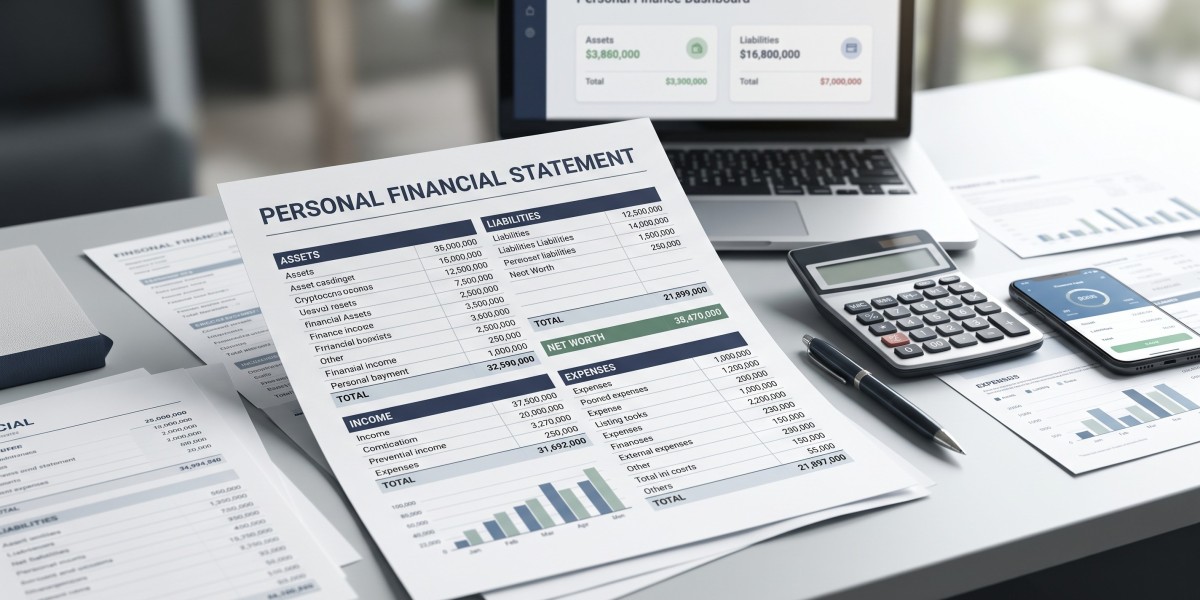

Managing personal finances becomes much easier when you have a clear picture of what you own, what you owe, how much you earn, and where your money is going. A personal financial statement provides a structured way to organize this information and understand your overall financial position. Whether you are applying for a loan, preparing for a major purchase, reviewing your financial goals, or simply trying to improve money management, having an accurate financial statement can provide valuable insight.
A financial statement is not only useful for banks and lenders. It can also be used by individuals to monitor their financial progress and make better-informed decisions. When your assets, liabilities, income, and expenses are documented clearly, financial strengths and weaknesses can be identified more easily.
What Is a Personal Financial Statement?
A personal financial statement is a document that summarizes an individual's financial position at a specific point in time. It generally provides information about assets, liabilities, income, and expenses.
Unlike a simple bank account summary, a financial statement can provide a broader view of your finances. Your savings account may show how much cash you currently have, but it does not necessarily show your property, investments, debts, monthly obligations, or other financial commitments.
A well-prepared statement can include:
- Cash and checking account balances
- Savings and investment accounts
- Real estate and other property
- Vehicles and valuable personal assets
- Retirement accounts
- Credit card balances
- Mortgage and other loans
- Personal debts
- Monthly income
- Regular living expenses
- Other financial obligations
The information should be updated regularly so that the document continues to represent your current financial situation.
Why Is a Personal Financial Statement Important?
Understanding your financial position is one of the foundations of effective money management. Without organized financial information, it can be difficult to determine whether you are actually moving toward your financial goals.
A personal financial statement can help bring different areas of your financial life together in one place.
For example, you may have a good monthly income but also carry substantial debt. Looking only at income could make your financial position appear stronger than it really is. Once liabilities are included, a more realistic picture can be developed.
This information may help you:
- Identify financial strengths and weaknesses
- Track changes in net worth
- Understand your debt obligations
- Prepare for borrowing
- Plan major purchases
- Review investment decisions
- Set realistic financial goals
- Monitor long-term financial progress
Because the information is organized systematically, financial decisions can be based on actual numbers rather than assumptions.
What Information Should Be Included?
The exact format can vary depending on its purpose, but most personal financial statements contain several important categories.
Assets
Assets represent things that have financial value and are owned by you.
Common examples include:
- Cash
- Bank accounts
- Stocks and bonds
- Retirement savings
- Real estate
- Vehicles
- Business interests
- Valuable personal property
Assets are generally recorded using their current estimated value rather than what was originally paid for them.
For example, if you purchased a vehicle several years ago, its current market value may be significantly different from its original purchase price. Using a realistic current value can make the statement more useful.
Liabilities
Liabilities are financial obligations that you owe to other individuals, businesses, or financial institutions.
They may include:
- Mortgages
- Auto loans
- Student loans
- Credit card balances
- Personal loans
- Medical debts
- Business-related debts
The outstanding balance should generally be recorded so that your current debt position can be evaluated accurately.
Income
Income represents money received during a specific period. Depending on your circumstances, this could include:
- Salary
- Self-employment income
- Business income
- Rental income
- Investment income
- Pension income
- Other recurring sources of income
A consistent income record can help show how much money is available to cover expenses and financial obligations.
Expenses
Expenses represent the money you regularly spend. These can include both fixed and variable costs.
Examples include:
- Housing payments
- Utilities
- Groceries
- Transportation
- Insurance
- Loan payments
- Education expenses
- Entertainment
- Subscriptions
- Other household costs
When expenses are documented carefully, unnecessary spending patterns can often be identified.
How Is Net Worth Calculated?
One of the most useful pieces of information that can be derived from a financial statement is net worth.
The basic calculation is:
Net Worth = Total Assets − Total Liabilities
For example, imagine that your assets have a combined value of $250,000 while your outstanding liabilities total $100,000.
Your estimated net worth would be:
$250,000 − $100,000 = $150,000
This number can provide a snapshot of your financial position.
Net worth should not be viewed as a measure of personal success or failure. Instead, it can be used as a financial tracking tool. If your net worth increases over time because debts are being reduced or assets are growing, that may indicate positive financial progress.
When Might You Need a Personal Financial Statement?
There are several situations where a detailed financial statement can be particularly useful.
Applying for a Loan
Lenders may request financial information when an individual applies for certain types of financing. A clear statement can make it easier to organize the information needed during the application process.
Depending on the lender and loan type, supporting documents may also be requested to verify income, assets, debts, or other financial details.
Planning a Major Purchase
If you are considering purchasing a home, vehicle, or another expensive asset, reviewing your finances beforehand can help determine what you can realistically afford.
A financial statement can help you compare:
- Available assets
- Existing debts
- Monthly income
- Current expenses
- Potential new payments
This can reduce the risk of taking on an obligation that places unnecessary pressure on your budget.
Monitoring Financial Progress
Financial circumstances change over time. Salaries may increase, investments may grow, debts may be paid down, and major assets may gain or lose value.
Updating your financial statement periodically allows these changes to be tracked.
For example, an annual review can help you determine whether:
- Your debt is decreasing
- Your savings are increasing
- Your investments are growing
- Your expenses are under control
- Your overall net worth is improving
How Can You Prepare an Accurate Financial Statement?
Accuracy is important because financial decisions may be influenced by the information presented.
Start by gathering current financial records. Bank statements, investment statements, loan documents, property records, and other relevant documents can be used to verify the numbers.
Then organize the information into clear categories.
A simple process can be followed:
- List all major assets.
- Estimate or verify their current values.
- Record outstanding liabilities.
- Add recurring sources of income.
- Document regular expenses.
- Calculate total assets and liabilities.
- Determine your estimated net worth.
- Review the statement for missing or inaccurate information.
Values should not be exaggerated simply to make your financial position appear stronger. Conservative and realistic estimates are generally more useful for personal planning.
Common Mistakes to Avoid
A financial statement can only be useful when the information is reliable. Several common mistakes can reduce its value.
Forgetting Smaller Debts
Small balances may seem insignificant individually, but several outstanding obligations can add up. Credit cards, personal loans, subscriptions, and other recurring commitments should be reviewed.
Using Outdated Asset Values
Property, vehicles, and investments can change in value. Using an old purchase price may provide an inaccurate picture of your current financial position.
Ignoring Recurring Expenses
Some expenses are easy to overlook because they are automatically charged. Subscriptions, insurance premiums, memberships, and other recurring costs should be considered.
Mixing Personal and Business Finances
If you own a business, personal and business finances should generally be tracked separately where appropriate. Mixing the two can make it harder to understand your actual personal financial position.
Failing to Update the Statement
A statement that was accurate two years ago may no longer reflect your current situation. It should be reviewed periodically, especially after major financial changes.
How Technology Can Make Financial Tracking Easier
Financial information can now be organized using spreadsheets, budgeting applications, accounting software, and other digital tools. These tools can reduce manual calculations and make updates easier.
However, technology does not eliminate the need for careful review. Information imported automatically should still be checked for accuracy.
Sensitive financial information should also be protected. Strong passwords, secure devices, multi-factor authentication, and reputable financial platforms should be used whenever financial records are stored digitally.
How Can a Personal Financial Statement Support Better Financial Decisions?
A financial statement can turn scattered financial information into something that can be reviewed systematically.
Suppose you are considering taking on a new loan. Instead of focusing only on the proposed monthly payment, you can review your existing obligations, income, savings, assets, and expenses together.
This broader view can help you ask better questions:
- Can the new payment comfortably fit within my budget?
- How much debt do I already have?
- Do I have enough emergency savings?
- Will this purchase affect my other financial goals?
- Is my current debt decreasing or increasing?
- How will this decision affect my net worth?
Better decisions are often made when the complete financial picture is considered rather than one isolated number.
Reviewing Your Financial Statement Regularly
There is no single schedule that works for everyone, but reviewing your financial position at least once or twice a year can be useful. More frequent reviews may be appropriate when your financial circumstances are changing quickly.
A review can also be performed after major life or financial events, such as:
- Starting a new job
- Purchasing a home
- Paying off a major loan
- Starting a business
- Receiving a significant financial windfall
- Changing investment strategies
- Taking on substantial new debt
During each review, outdated information should be replaced and unusual changes should be investigated.
Final Thought
A personal financial statement is more than a document containing numbers. It is a practical tool that can help you understand where you currently stand financially and make decisions with greater confidence. By organizing assets, liabilities, income, and expenses in one place, financial patterns become easier to recognize and long-term progress can be measured. Whether it is being prepared for a lender, a major purchase, or personal financial planning, an accurate and regularly updated statement can provide a clearer foundation for responsible money management.